
My Rate Is Fixed. Why Did My Mortgage Payment Go Up?

Frank Burks II · NMLS #841644
· 4 min read
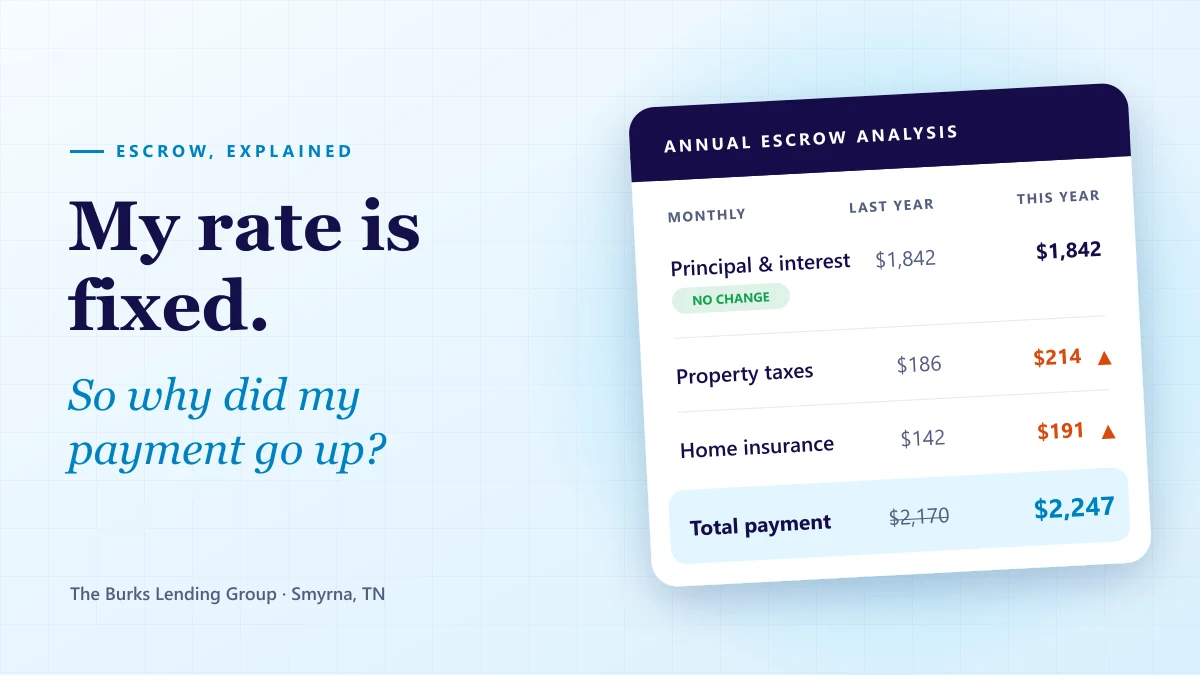
The envelope looks harmless. Then you open it and your mortgage payment jumped $200, $300, sometimes more. And you’re standing in the kitchen thinking, “Hold on. I locked a fixed rate. Fixed means fixed.”
You’re right about the rate. It didn’t move. But your payment carries passengers, and two of them just asked for a raise.
Why did my mortgage payment go up if my rate is fixed?
Your interest rate and your principal and interest payment stay the same for the life of a fixed-rate loan. Most payments also include escrow for property taxes and homeowners insurance. When either bill goes up, your servicer raises the escrow part of your payment to cover it. The rate never changed. The bills did.
Think of your payment as a car with three riders. Principal and interest sit up front, seatbelts on, going nowhere. Taxes and insurance ride in the back, and they don’t ask permission before they stretch their legs.
What is an escrow analysis?
An escrow analysis is a yearly review your servicer runs on your escrow account. It compares what you paid in against what went out for taxes and insurance, then projects next year’s bills. If the account came up short, or next year looks more expensive, your monthly payment goes up. Federal rules require this review at least once a year.
That letter usually shows three things: a shortage or surplus, your new monthly escrow amount, and a cushion. Servicers can keep a cushion of up to two months of escrow payments, so a bump in your bills shows up in more than one place.
What is an escrow shortage, and do I have to pay it all at once?
An escrow shortage means your account didn’t hold enough to cover last year’s bills plus the allowed cushion. In most cases you can pay it in one lump sum, or let your servicer spread it over the next 12 months. Paying it upfront keeps your new monthly payment lower. Spreading it out costs nothing extra but raises the payment for a year.
Here’s the part that stings. A shortage plus a higher projected bill can hit you twice in the same letter: once to catch up, and once to keep up. That’s how a payment climbs a few hundred dollars without your rate moving an inch.
And if the analysis finds a surplus of $50 or more, your servicer generally has to refund it within 30 days. Good news travels in envelopes too.
Why are property taxes going up in Middle Tennessee?
Tennessee counties reappraise property on a regular cycle, and Middle Tennessee home values have climbed fast. When a reappraisal catches up with the market, your assessed value can jump, and so can your bill. City and county rate changes play a part too. Smyrna, Murfreesboro, La Vergne and Lebanon homeowners can see different bills on similar homes.
Two moves worth making: read your assessment notice when it arrives, because Tennessee gives you a window to appeal. And if you’re 65 or older, or a disabled veteran, ask your county trustee about Tennessee’s property tax relief and tax freeze programs.
Why is homeowners insurance going up in Tennessee?
Rebuilding costs, storm claims and reinsurance prices have pushed premiums up across the country, and Tennessee feels it too. Insurers file their rate changes with the state, and the Tennessee Department of Commerce and Insurance posts those filings every month. Shopping your policy every year or two is one of the few escrow costs you can actually control.
You can see who filed what on the state’s monthly homeowners rate page. It won’t pick a policy for you, but it shows you who’s been raising rates.
What can I do about a higher mortgage payment?
You have more control than the letter makes it feel. Here’s where I start with homeowners:
- Shop your homeowners insurance. Compare coverage, not just price, and send the new declarations page to your servicer.
- Check your tax assessment. If it looks high next to similar homes on your street, look into an appeal.
- Ask about relief programs if you’re 65 or older or a disabled veteran.
- Pay the shortage upfront if you’d rather keep the monthly payment lower.
- Review the whole loan. Equity, mortgage insurance and today’s options can change the math.
If you’re buying a home right now
Budget for the whole payment, not just the part that sits still. When I run numbers for buyers, I use real tax and insurance figures for the street they’re buying on, not a guess. A comfortable payment in year one should still be comfortable in year three.
Want a ballpark first? The mortgage payment calculator breaks out taxes and insurance so you can see the whole picture.
Let’s look at your letter together
Got an escrow letter that made your stomach drop? Send it to me. I’ll walk you through it line by line, plain English, no pressure. If you bought with me, ask for your Annual Mortgage Review and we’ll look at the whole loan.
Call or text 615.364.5700, book a time on my calendar, or if you’re buying, start your Secure Application.
Fixed rate. Not a fixed payment. Let’s make sure yours still fits.
Everybody Deserves a Key.
This article is educational and is not tax, legal or insurance advice.
Frequently asked questions
Can my mortgage payment go up on a fixed-rate loan?+
Yes. Principal and interest stay fixed, but property taxes and homeowners insurance paid through your escrow account can rise, and your payment rises with them.
How often does my escrow change?+
Your servicer reviews your escrow account at least once a year and can adjust your monthly payment after each review.
Do I have to pay an escrow shortage all at once?+
Usually not. Most servicers let you pay the shortage in one lump sum or spread it over the next 12 monthly payments.
Can I get rid of escrow?+
Sometimes. It depends on your loan type, your equity and your servicer's rules. FHA and VA loans generally require it.
Will refinancing lower my escrow?+
Not by itself. Taxes and insurance follow the house, not the loan. A refinance can change your principal and interest, though.
Written by
Frank Burks II, Mr. Clear 2 Close
Certified Mortgage Advisor with 25+ years helping Middle Tennessee families get to the closing table. NMLS #841644. The Burks Lending Group empowered by NEXA Lending, NMLS #1660690.
Want real numbers for your situation?
Every scenario is different. Let's talk through yours. No pressure, no jargon.
This article is for general educational purposes and is not a commitment to lend or financial advice. Loan programs, guidelines, and rates change and vary by lender and borrower. Contact Frank for guidance on your specific situation.